Why Underbody Anti-Corrosion Treatment Is Non-Negotiable for Bangalore's Monsoon Season
Bangalore's monsoon is not gentle. From June through October, the city receives relentless rainfall, waterlogged roads, and a level of humidity that lingers long after the rain stops. While most car owners focus on windshield visibility, tyre grip and interior dampness during this season, they ignore the one area of the car that takes the worst beating — the underbody.
Underbody anti-corrosion treatment for Bangalore's monsoon is not a luxury add-on or a dealership upsell. It is one of the most practical, cost-effective investments a Bangalore car owner can make to protect the structural integrity and long-term value of their vehicle. This guide explains exactly why — and what you need to do about it before the rains arrive.
What is Underbody Anti-Corrosion Treatment?
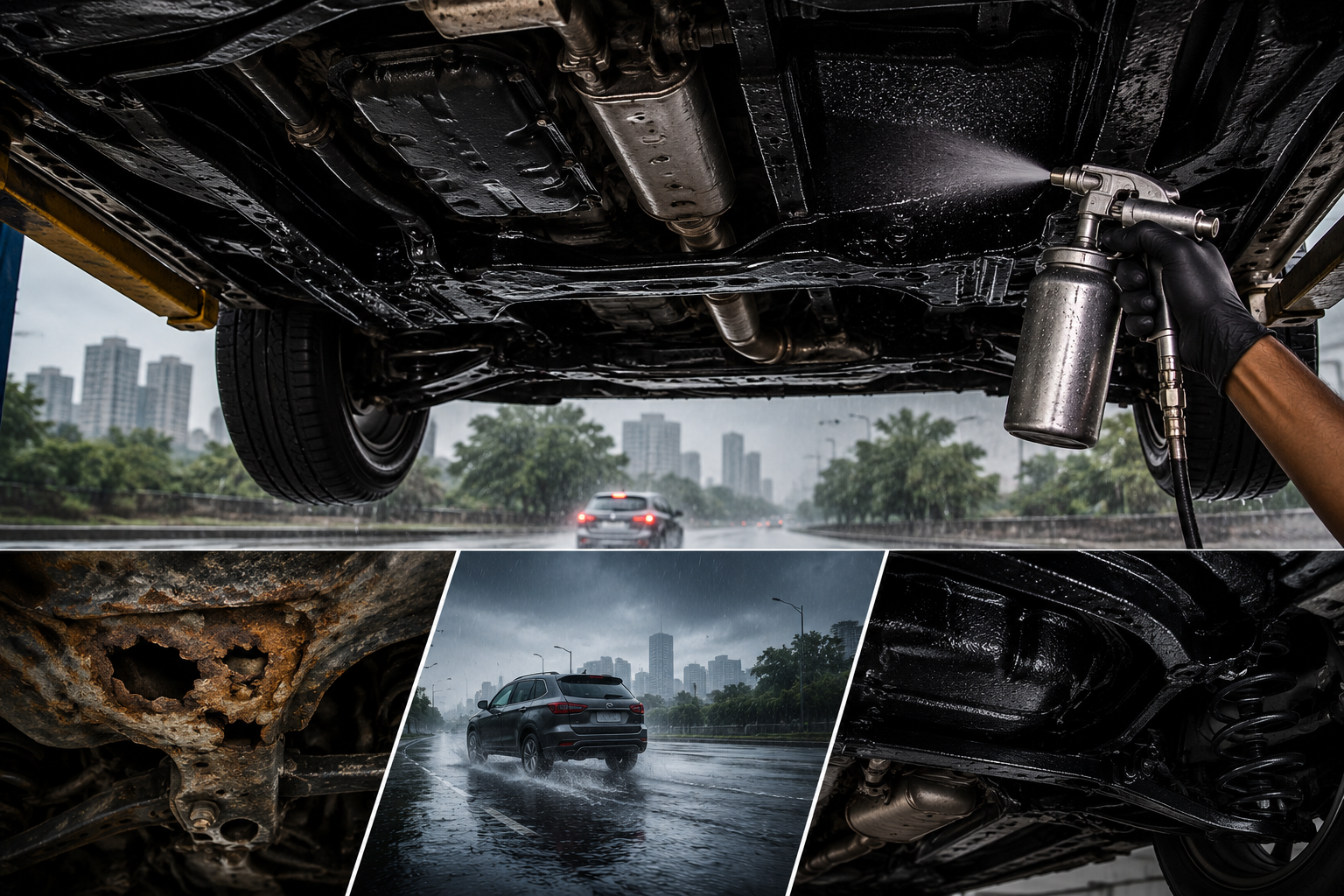
Underbody anti-corrosion treatment is the application of a protective coating to the underside of your vehicle — the metal chassis, floor panels, wheel arches, axles, exhaust system and suspension components. This coating acts as a barrier between bare metal and the moisture, mud, road debris and chemical contaminants that constantly bombard your car's underbody every time you drive.
The treatment typically uses one of the following materials:
-
Rubberised underbody coating: A thick, flexible rubber-based compound that seals metal surfaces and absorbs impact from road debris
-
Wax-based underbody sealant: A penetrating wax formula that gets into joints and crevices where moisture tends to collect
-
Epoxy-based coating: A hard, durable layer suitable for high-exposure metal surfaces
-
Polyurethane spray coating: A premium, long-lasting solution used in professional automotive detailing
Once applied, this coating prevents water, mud and oxygen from reaching the bare metal — stopping the oxidation process that leads to rust and structural corrosion.
Why Bangalore's Monsoon is Especially Dangerous for Car Underbodies
Underbody anti-corrosion treatment for Bangalore's monsoon is particularly critical because of the specific conditions this city creates during the rainy season:
-
Waterlogged Roads: Bangalore's drainage infrastructure frequently struggles during heavy rainfall. Driving through standing water, even briefly submerges your underbody in a cocktail of rainwater, road chemicals, oil residue and particulate matter that accelerates corrosion.
-
Humidity That Does Not Leave: Even on days when it is not actively raining, Bangalore's monsoon humidity levels stay extremely high. This ambient moisture penetrates every joint, seam and exposed metal surface beneath your car — working silently to initiate and spread rust.
-
Road Salt and Chemical Runoff: Bangalore roads carry accumulated diesel, motor oil, brake fluid and cleaning chemicals that mix with rainwater and splash directly onto your underbody during every drive. These chemical compounds are significantly more corrosive than plain water alone.
-
Stop-and-Go Traffic: Bangalore's notorious traffic means your car spends hours at low speeds — repeatedly driving through puddles and splash zones that a faster-moving vehicle would clear more efficiently.
-
Rough Road Surfaces: Monsoon season accelerates road deterioration. Potholes, broken edges and exposed tar cause underbody impacts that chip away existing factory underbody coatings — leaving raw metal directly exposed to moisture.
All of these factors combined make underbody anti-corrosion treatment for Bangalore's monsoon an urgent priority — not a seasonal afterthought.
What Parts of Your Car Are at Risk?
The underbody of a car contains several critical components that are directly exposed to road conditions:
-
Chassis and frame — The structural backbone of your vehicle. Rust here is a serious safety concern.
-
Floor panels — Thin sheet metal that forms the floor of your car. Corrosion here eventually leads to visible rust holes inside the cabin.
-
Wheel arches — Constantly hit by mud, gravel and water spray. Factory coatings in this area wear off within 2 to 3 years in Indian conditions.
-
Exhaust system — Exposed to extreme heat and constant moisture. Rust on the exhaust leads to leaks and performance issues.
-
Suspension components — Springs, control arms and subframes that corrode silently, affecting ride quality and safety over time.
-
Brake lines and fuel lines — Metal lines running along the underbody that can develop rust-induced leaks — a direct safety hazard.
-
Differential and axle housings — Heavy-duty metal components that are vulnerable to long-term moisture exposure.
Once rust takes hold in any of these areas, repair costs escalate rapidly. Prevention through underbody anti-corrosion treatment for Bangalore's monsoon is always a fraction of the cost of repair.
How Underbody Anti-Corrosion Treatment Works
A professional underbody anti-corrosion treatment follows this process:
-
Step 1 — Underbody Cleaning and Inspection The vehicle is lifted on a hydraulic ramp. The underbody is high-pressure cleaned to remove existing mud, grease, road tar and any loose material. A thorough inspection checks for existing rust spots or coating damage.
-
Step 2 — Surface Preparation Any existing rust is treated and neutralised before the new coating is applied. Applying coating over active rust without treatment is a common mistake at low-quality service centres — it seals rust in rather than stopping it.
-
Step 3 — Masking Exhaust tips, sensors, drain plugs and other components that should not be coated are carefully masked off.
-
Step 4 — Coating Application The chosen underbody compound — rubberised, wax-based or polyurethane — is spray-applied in even, overlapping passes to ensure complete coverage including joints, seams and wheel arch interiors.
-
Step 5 — Curing and Drying The coating is allowed to cure for 1 to 4 hours depending on the product. Some coatings require the vehicle to avoid water exposure for 24 hours post-application.
-
Step 6 — Quality Check The vehicle is inspected under the ramp to confirm uniform coverage with no missed areas or thin spots.
Signs Your Car Already Has Underbody Rust Damage
Before getting underbody anti-corrosion treatment for Bangalore's monsoon, check for these early warning signs:
-
Visible orange or brown patches on the underside when you look beneath the car
-
Bubbling or flaking paint on wheel arches or door sills — rust spreads from the underbody upward
-
Musty or damp smell inside the cabin — often indicates floor panel corrosion allowing moisture to seep in
-
Squeaking or creaking suspension — corroded suspension joints make noise under load
-
Rust-coloured water dripping from underneath after a wash or rainfall
-
Visible holes in floor panels in older vehicles — the most advanced stage of underbody corrosion
If any of these signs are present, a rust treatment and neutralisation step must be done before the anti-corrosion coating is applied.
When is the Best Time to Get It Done?
The ideal window is April to May — just before the monsoon arrives. This gives the coating full time to cure and bond before the rains begin.
However, it can also be done:
-
During monsoon — as long as the car is dry at the time of application and kept dry for 24 hours after
-
Post-monsoon — to repair and recoat after the season's damage assessment
-
At the time of a new car purchase — factory underbody coatings are thin and often inadequate for Indian road conditions
For existing cars, an annual inspection and recoating every 2 to 3 years is the recommended maintenance cycle — more frequently if the vehicle is used heavily in flooded or rough road conditions.
How to Choose the Right Service Provider in Bangalore
Not all underbody treatments are equal. Here is what separates a quality service centre from a substandard one:
-
Hydraulic ramp access — The entire underbody must be accessible for proper application. No shortcuts from beneath a partially lifted vehicle.
-
Surface preparation first — A good centre inspects, cleans and treats rust before applying any coating
-
Named product brands — Ask what coating product is being used. Reputable centres use named brands, not generic compounds
-
Warranty on application — Minimum 1-year warranty on the coating is a sign of confidence in the work
-
Before and after documentation — Photos of the underbody pre and post treatment should be standard
li>
Experienced technicians — Underbody work requires trained hands, not general mechanics